
Japan’s Radical Experiment

Japan didn’t choose humanoid robots to care for its elderly.
It was forced to.
Faced with one of the most severe demographic collapses in modern history — nearly 29% of its population already over 65 and a projected shortage of hundreds of thousands of caregivers by 2040 — the country made a deliberate strategic choice: instead of relying heavily on mass immigration, it is betting aggressively on humanoid and advanced care robots as a national solution.
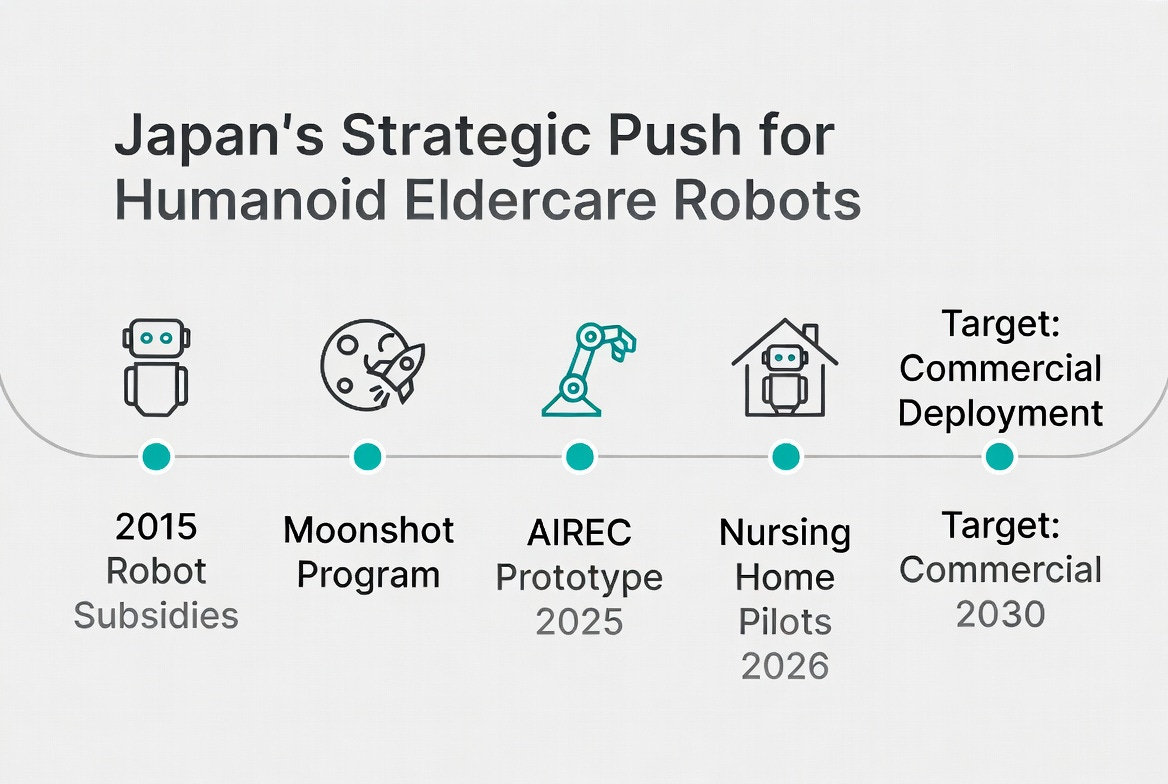
In 2026, this experiment has moved from policy papers and trade show demos into active pilot deployment and heavy government subsidies. Projects like the AIREC humanoid (Waseda University, backed by the Moonshot program and NVIDIA technology) are demonstrating real physical caregiving tasks — lifting patients, repositioning in bed, assisting with daily living activities — that were long considered too complex for machines.
This is one of the clearest and most consequential real-world tests of humanoid robotics we have today.
Why Japan Is the Perfect (and Urgent) Laboratory
Japan’s aging crisis is extreme. The working-age population is shrinking rapidly, caregiver burnout is high, and labor costs in eldercare are rising. Traditional solutions are hitting political and practical walls.
The government has responded with one of the world’s most aggressive robotics strategies: substantial subsidies (often 50-90% in some prefectures), dedicated R&D funding, and explicit policy support to make care robots a core part of “Society 5.0”.
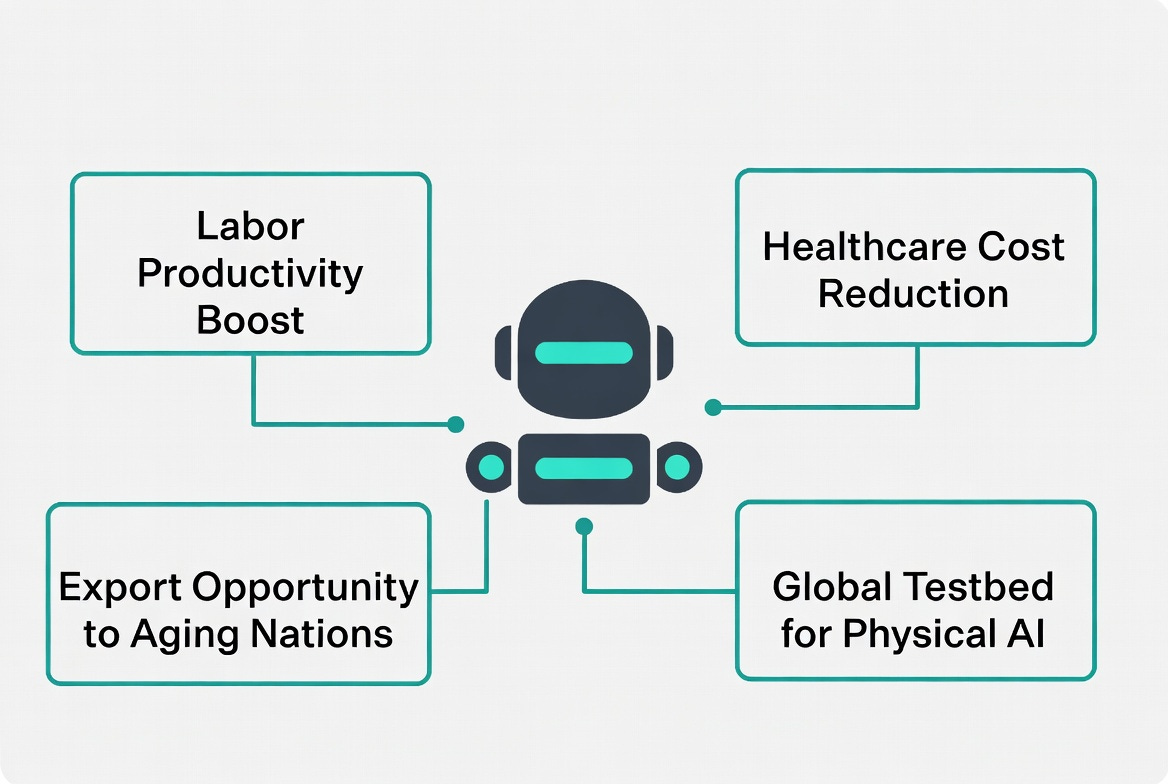
The economic logic is compelling: if humanoid robots can safely multiply the productivity of each human caregiver and enable more elderly people to age in place, Japan could avoid massive fiscal strain and set a model for other aging nations (South Korea, China, Italy, Germany).
The Current State in 2026
Advanced prototypes like AIREC are already showing capability in complex physical tasks.
Major corporations (Toyota, Honda, SoftBank Robotics, Panasonic, Mitsubishi Heavy) are accelerating development for eldercare applications.
The eldercare assistive robots market in the region is growing at strong double-digit rates, with the humanoid segment showing even higher potential.
This creates a unique situation: a large, well-funded domestic “proving ground” with immediate demand and policy support — exactly what the humanoid robotics industry needs to move from pilot to commercial scale.
The Tech Economics thesis is powerful: Japan’s demographic pressure is acting as a massive forcing function for humanoid robotics. The country that solves reliable, safe, and cost-effective physical assistance robots for eldercare first will gain enormous advantages — both in domestic productivity and as a potential exporter to the many other societies that will soon face the same challenge.
This free section gives you the macro context, the current technical and policy progress, and why this theme is one of the highest-conviction intersections of demographics, AI, and robotics right now.
For paid Tech Economics subscribers (full analysis unlocked immediately below):
We deliver the complete investor toolkit:
Detailed comparison of the leading players and technologies (Japanese vs global competitors)
Economic modeling: cost curves, ROI, and productivity impact of humanoid care robots
Specific investment opportunities across hardware, software, sensors, and supply chain
Global ripple effects and scenario planning (what if Japan succeeds — or if progress is slower?)
Catalyst calendar for 2026-2028 and clear positioning framework
The future of physical AI and the economics of aging societies are being stress-tested in Japan right now.
If you want to understand the real drivers behind the humanoid robot wave — and how to position capital ahead of the narrative shift — the full report is ready for subscribers…
Japan’s Humanoid Care Bet
The free section made the case for why Japan is the forcing function. This premium section is how to act on it: a player-by-player comparison (Japan vs. global), the actual unit economics of a care humanoid vs. a human caregiver, the investable supply chain layer by layer, scenario planning, a dated 2026–2028 catalyst calendar, and a positioning framework. All figures verified against company disclosures, government data, and analyst research as of mid-June 2026. Where sources diverge, we show the range — and we flag where the free-section numbers need nuance…